
FAQs
Q. Is the privatization of UC just part of a national trend beyond the control of UC leadership and the Governor?
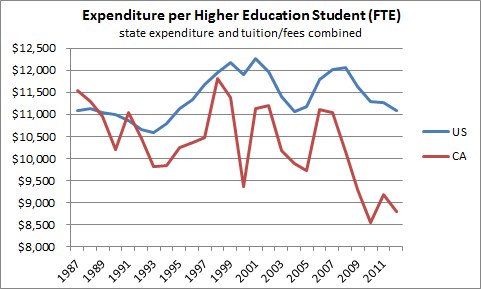
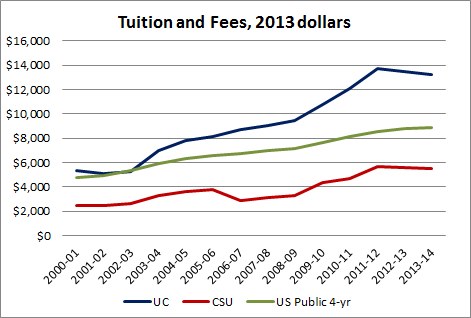
A. No. In fact, the cuts in California, adjusted for student enrollment and inflation have been much larger and the fee increases have been much larger than the average for other colleges. California used to be different because its students got exceptionally high value for their educational dollar. California’s policies are rapidly increasing costs while cutting quality.
Q. Why do executive salaries keep increasing at the same time that student fees climb, quality erodes, and faculty and staff salaries backslide?
A. Administrators justify these compensation packages on the grounds that higher education systems are complex enterprise and that market demands such salaries. This view reflects a corporate mentality that sees the quality of higher education as determined by top executives, not the students, faculty and staff at the bottom.
More important, it is a symptom of the creeping privatization of higher education. As the governors reduce public support for UC and CSU, more and more of UC and CSU’s leaders’ time goes to private fundraising, less to administering higher education as a public trust. From this perspective, privatized universities have to pay private sector salaries to the people at the top.
Restoring public support for public higher education should be accompanied by adjusting administrators’ salaries to what is a appropriate for publicly-supported institutions.
Q. Why not just increase the number of out of state students as a way to make money?
A. It is unlikely to work and has real costs. While in 1986 California imported 4,124 more freshmen than it exported to other states, by 2006 this situation had reversed, with 2,384 more freshmen leaving California than coming. Price probably contributed to this trend. At the flagship UC Berkeley campus 2008 tuition and fees were $8,385, higher than the national average for other flagship universities of $7,029. UC fees had increased by 60% between 2004 and 2008, the third highest increase among all flagship universities during this period (Details). Increasing out-of-state enrollment will necessarily come at the expense of reducing the number of opportunities for California students, further reducing higher education’s claim on state resources. And, like other privatization schemes, it won’t solve the financial problem.
Q. Isn’t the University of Michigan a good model for UC in the face of declining state support?
A. When the University of Michigan moved to a semi-privatized model, it reduced access for residents to allow greater enrollment of non-residents who are charged much more for tuition. Admission standards were relaxed to increase out-of-state enrollment. Over half of Michigan’s 2003 freshman class came from families with six-figure incomes in a state where only 13% of families earn that much. The result has been significantly diminished access for the residents of Michigan, especially the most disadvantaged, and a reduction in the quality of the University as seen in its drop in rankings by U.S. News and World Report.